Wasps and hornets are skilled nest builders who thrive in various settings, from wall cracks and open areas to tree hollows and underground spaces. It’s important to know how to identify wasp and hornets nests because these insects often react aggressively when disturbed or when someone comes too close to their nest.
To help you prevent painful stings, we will show you how to identify the nests of various stinging insects.
How Do You Tell the Difference Between Stinging Insect Nests?
In Indiana, Illinois, Kentucky and Ohio, we deal with four main types of aggressive wasps: paper wasps, yellowjackets, bald-faced hornets, and European hornets. (Yes, yellowjackets and hornets are classified as wasps). Each species builds its own distinctive style of nest; here’s how you can tell the difference.
Paper Wasp Nests
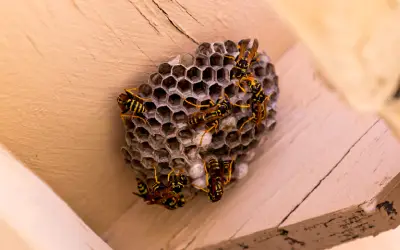
This is a fairly typical paper wasp nest with its characteristic open structure.
Paper wasp nests are distinctive for their open design, resembling an upside-down umbrella with exposed hexagonal cells.
Structure: Single-layer comb without an outer papery covering.
Material: Plant fibers mixed with saliva to create a grey or tan “paper.”
Location: Typically found in sheltered areas like porch ceilings, window frames, or door jams, suspended by a single, thin stalk called a pedicel.
Size: Generally small, housing 15 to 30 wasps.
Yellowjacket Nests
Yellowjackets prefer “hidden” nesting sites, most commonly utilizing abandoned rodent burrows or cavities within building walls. Because the nest is usually underground, you may only see a small hole with constant insect traffic.
Structure: Multi-layered combs completely enclosed by a thick, papery envelope.
Material: Roughly chewed wood fibers, often appearing tan or grey.
Location: Primarily subterranean, but can be found in attics or hollow trees.
Size: High population; a single nest can contain thousands of individuals.
European Hornet Nests
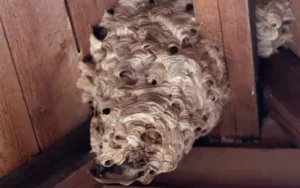
This is what a European hornets’ nest looks like. Note the unusual shape.
European hornets typically choose large, natural cavities for their homes, such as hollowed-out tree trunks or chimneys. Unlike their cousins, they rarely build nests in the wide open, preferring the protection of a pre-existing shell.
Structure: Massive combs that are often unprotected by an outer envelope if the cavity provides enough shelter.
Material: Darker, brownish paper compared to the grey of other hornets.
Location: Hollow trees, barns, attics, or abandoned outhouses.
Size: Substantial size but usually fewer individuals than a yellowjacket colony.
Bald-Faced Hornet Nests
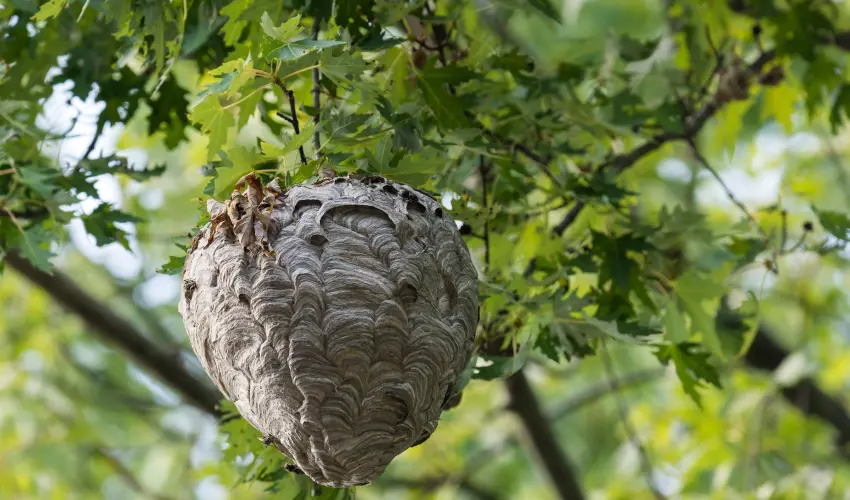
These nests are the classic “football-shaped” structures seen hanging high in tree branches or from the peaks of houses. They are fully enclosed with a single entry hole located near the bottom.
Structure: Large, aerial, and multi-tiered combs hidden inside a sturdy outer shell.
Material: Strong, grey paper made from weathered wood.
Location: Usually 10 to 30 feet above the ground in trees or on utility poles.
Size: Can grow to be larger than a basketball by late summer.
Take Action Against Unwanted Pests
At Action Pest Control, we’re always ready to help you with your pest control needs. Contact us for a free, no obligation quote, or call us at 877-420-0849 to get started today.
Wasps and hornets will thoroughly scout an area for suitable nesting sites, and once they’ve chosen a location, it’s very difficult to deter them. However, you can lower the risk by understanding what makes certain areas appealing for nesting, eliminating those factors if possible, or closely monitoring those spots and taking action at the very first sign of a problem.
These are some of the most common nesting locations that wasps and hornets choose:
Exposed Locations: Hornets commonly hang their nests openly from tree branches or large shrubs where they are easily visible.
Sheltered Areas: Bald-faced hornets and yellowjackets often prefer nests under roof overhangs, in sheds, or on porches where they find protection.
Ground Nests: Less commonly, some species may establish nests at or just below the ground’s surface.
Hollow Trees: Natural cavities in trees provide a secure and sheltered environment perfect for hornet colonies.
Wall Voids: European hornets frequently choose hidden cavities within walls of buildings as safe nesting sites. You can deter them by sealing these voids as soon as you notice them.
Can You Eliminate a Stinging Insect Nest Yourself?
People attempt DIY wasp nest removal all the time, but it’s important to understand the risks. Wasps and hornets are especially aggressive when they perceive a threat to their nest, so once you strike, you have to be prepared to get to safety as soon as possible.
While we strongly recommend working with a professional wasp exterminator for nest removal, if you decide to DIY, here are some tips on how to do it as safely as possible. Note that following these tips won’t eliminate your risk of getting stung – but it will reduce it.
Dress for Protection: Wear thick, long-sleeved clothing, gloves, and tuck your pants into your socks. Wasps will try to sting exposed skin or get into clothing gaps.
Wait for Inactivity: Wasps are most active (diurnal) during the day. Wait until after sunset or approach the nest very early in the morning when the colony is less alert.
Choose the Right Tool: Use a long-range foaming hornet and wasp spray that allows you to stand at least 15 to 20 feet away from the nest.
Plan Your Retreat: Identify your clear exit path before you begin spraying to ensure you have no tripping hazards if you are chased by wasps.
Target the Entrance: Find the main entry point and spray the product directly into the hole. The interior of the nest must be treated, not just the exterior surface.
Allow Time to Work: Wait 24 hours after spraying. This ensures maximum contact with the residue for all wasps before the next step.
Remove the Nest: Once you observe no wasp activity, knock the nest down using a broom or a long pole.
Secure and Dispose: Place the removed nest into a bag and seal it tightly. This is critical because even a “dead” nest can still contain pupae that could hatch later.
Need Help With Wasp or Hornet Nest Removal?
Discovering a hornet nest on your property can be overwhelming and dangerous. Avoid injury by leaving removal to our expert team. We’ll safely handle the nest to protect your home and family. Find out more about our professional nest removal services today!
Contact Action Pest Control today for a free quote and personalized expert advice to meet your pest control needs.
FAQs
What is the difference between a hornet nest and a wasp nest?
Hornet nests tend to be larger, spherical, and constructed from a gray, paper-like material. They are often found in trees or under roof eaves. Wasp nests, however, vary greatly in shape, size, and materials depending on the species. They can be open hexagonal cells, comb-like formations, or fully enclosed nests. Both types serve as homes for their colonies.
How long will a hornet’s nest last?
Hornet nests typically last for one season. The queen begins building in spring, and the colony grows throughout summer. Once winter arrives, the colony dies, and the nest is abandoned since hornets rarely reuse old nests.
Should I be worried about a nest?
Don’t worry, but treat the situation with caution. Aggressive stinging insects can pose a danger. Hornets and wasps are defensive and can sting multiple times. It’s safest to keep your distance and contact a professional for removal.
Should I destroy a nest?
We recommend working with an experienced wasp exterminator, as trying to destroy a hornet’s nest on your own can trigger aggressive behavior, increasing the chance of stings and injury.
A pest control professional has the expertise and equipment to remove the nest safely.
Should I just leave a nest alone?
If the nest is in a remote area with no threat to people, it’s usually fine to leave it alone since the colony will die off in winter. However, nests close to homes or frequented spots should be dealt with by pest control experts.
On time , explained service, checked in after, provided personal contact info.
Read MoreRead Less
Pavla S.
Excellent service, highly recommend ✨😊
Read MoreRead Less
Zachary H.
David did great work!
Read MoreRead Less
Julie A.
We have been happy with their service and attention to detail. Our tech, Fred is professional and nice.
Read MoreRead Less
Linda K.
Every one I have met have been very helpful and they came out the same day to do my treatment.
Read MoreRead Less
David B.
The technician was professional and courteous. He answered all of my questions and made sure I was pleased with the service.
Read MoreRead Less
David D.
David was very prompt and sprayed my whole property for mosquitoes. He did a super job covering everything which we are very appreciative of. Great job David!
Read MoreRead Less
Barbara D.
Technician showed up on time to so outside spray for mice and when we mentioned ants inside he provided small any traps for inside. Very friendly and efficient.