
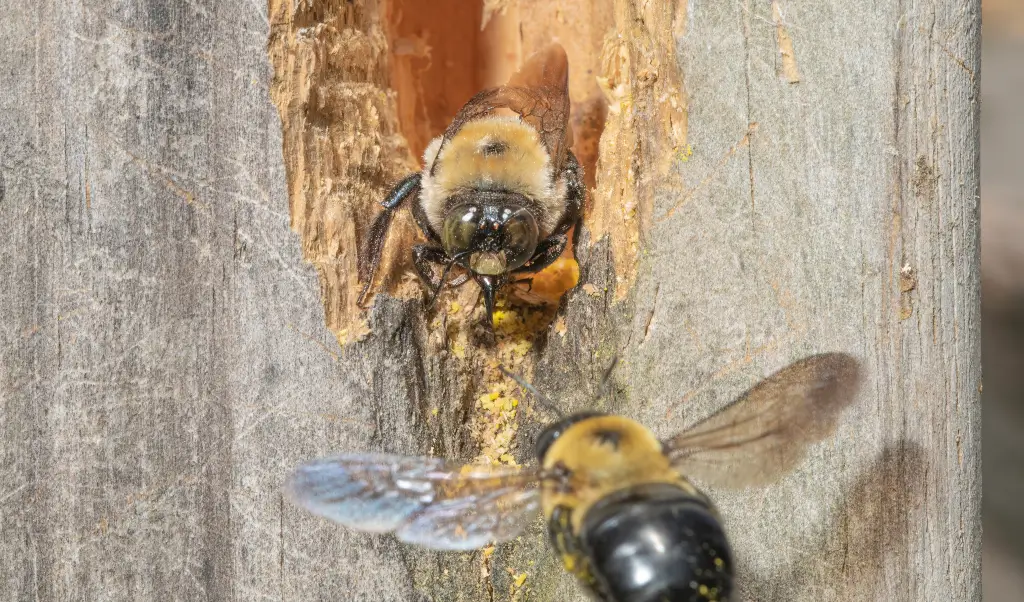
Carpenter bees are known for being fairly docile, and they rarely sting unless directly provoked. Still, they can lead to costly damage in homes across Indiana, Illinois, and Kentucky by steadily boring into exposed wood surfaces. In many cases, homeowners do not detect their activity until the damage has become extensive. Because of their ongoing tunneling behavior, professional carpenter bee control from Action Pest Control is frequently the best course of action.
These bees excavate wood to build nesting galleries where they lay eggs and raise their larvae. The young develop inside the wood, feeding until they mature and emerge as adults. The same nesting sites are often reused and enlarged each season if no treatment is applied. Our carpenter bee control services at Action Pest Control are designed to interrupt this pattern and protect your home from continued structural damage.
Carpenter Bees vs Regular Bees: Key Differences Explained
Although carpenter bees and regular bees often appear alike initially, they are actually quite distinct. Differences in their behavior, preferred habitats, and biological traits set them apart. The following outlines some of the main differences between carpenter bees and regular bees:
- Temperament: Carpenter bees often hover around people in a territorial manner but rarely sting, while regular bees are generally non-aggressive and will only sting when they feel threatened or disturbed.
- Social Behavior: Carpenter bees are naturally solitary insects and are most often seen alone or in small groups, while regular bees live in large, organized colonies that can consist of thousands of members.
- Nesting Habits: Carpenter bees create their nests by boring into wood and forming tunnels within structural materials, while regular bees typically build nests in trees, underground burrows, wall cavities, or other protected areas using wax comb structures.
- Pollination Role: Carpenter bees are generally less efficient as pollinators, whereas regular bees are essential contributors to pollinating flowers, agricultural crops, and a wide variety of plant species.
Identifying Carpenter Bees: Appearance and Features
Several clear traits set carpenter bees apart from other bee species. Their overall size, coloration, and smooth body surface are often the easiest ways to identify them near a home. Below are some of the main characteristics of carpenter bees:
- Body Color: Carpenter bees may exhibit a metallic sheen in shades of blue, green, or purple, whereas regular bees typically display softer gold-and-black striping with a more muted appearance.
- Thorax Coloring: Both carpenter bees and regular bees have fuzzy thoraxes, but carpenter bees often show a brighter, more vivid yellow coloring in this area that can appear more pronounced.
- Abdomen Texture: Carpenter bees have a smooth, shiny black abdomen with little to no hair, while regular bees are covered in fine fuzz across most of their bodies, giving them a softer look.
- Size and Shape: Carpenter bees are large, robust insects with a heavier body structure, while regular bees are generally smaller, more slender, and less bulky in appearance.
Take Action Against Unwanted Pests
At Action Pest Control, we’re always ready to help you with your pest control needs. Contact us for a free, no obligation quote, or call us at 877-420-0849 to get started today.
Why Action Pest Control Is a Top Choice for Carpenter Bee Control
There are plenty of carpenter bee control choices in Indiana, Illinois, and Kentucky, and we’re grateful you are considering Action Pest Control. Partnering with us means working with professionals committed to safeguarding your home from carpenter bees and the damage they create. Here’s how our trusted extermination services work:
- Experienced Technicians: Our exterminators are highly trained in carpenter bee behavior and region-specific treatment techniques. They are skilled at identifying active nesting sites, understanding seasonal patterns, and distinguishing between nesting and territorial behavior to ensure treatments are applied effectively.
- Transparent Communication: We provide a thorough assessment of carpenter bee activity along with a clear, step-by-step breakdown of the treatment plan. In addition, we offer helpful tips to minimize future wood damage and remain available to address any questions or concerns.
- Customized Treatment Plans: Our carpenter bee control strategies are tailored to the specific needs of your property. After a detailed inspection, we focus on active entry points, vulnerable wooden surfaces, and potential nesting sites to address current infestations and reduce the risk of future activity.
- Easy Online Management: Our user-friendly online system makes it simple to schedule services, handle payments, and stay updated on service progress. From beginning to end, managing your carpenter bee control services is designed to be smooth and convenient.
- Fast Local Response: We prioritize prompt response times from nearby carpenter bee control professionals who can help limit damage before it spreads. We understand that even small delays can result in more extensive structural issues and higher repair costs.
Carpenter Bee Control: Our Step-by-Step Process
When you get in touch with Action Pest Control, it is most often because carpenter bees are currently causing damage and endangering your property. Here is how we respond with fast removal and ongoing protection against these destructive insects:
- Thorough Inspection: We conduct a detailed, careful inspection of your property to identify active carpenter bee entry points and areas most susceptible to damage. Our team looks for clean, round holes in wood, small accumulations of sawdust-like material, yellow staining from bee activity, and the hovering presence of territorial males. This comprehensive assessment helps us determine the severity of the infestation and choose the most effective treatment approach.
- Advanced Treatment Methods: Our focused treatment methods are designed to eliminate carpenter bees and halt ongoing structural damage. We directly treat active tunnels, target developing insects within the wood, and apply protective barriers to at-risk areas, delivering both immediate control and long-term protection.
- Ongoing Prevention Plan: Our prevention strategy is designed to help keep carpenter bees from coming back. We offer practical guidance, recommend minor structural adjustments, and provide maintenance tips that reduce the appeal of your home to these pests, helping you prevent future infestations and avoid expensive repairs over time.
Carpenter Bee Removal You Can Rely On with Action Pest Control
DIY carpenter bee control rarely works well since these insects don’t rely on one main nest. Instead, their activity may be scattered across different parts of your property, and any missed spots can allow infestations to come back in Indiana, Illinois, and Kentucky. For this reason, expert treatment is strongly recommended. At Action Pest Control, we specialize in complete carpenter bee elimination and long-term prevention.
Contact Action Pest Control today for dependable, efficient carpenter bee removal from experienced professionals.
Carpenter Bees and Removal: FAQs
We have been proudly serving Indiana, Illinois, and Kentucky since 1946, earning a reputation as a dependable pest control leader through the effective removal of many carpenter bee infestations. Our mission is to protect homes from the damage and costly repairs these pests can cause.
Our real-world experience has given us valuable expertise on carpenter bees, which we’re always willing to share. From detecting infestations to recognizing potential long-term issues, we’ve got you covered.
If you still have questions, please don’t hesitate to contact us.
How destructive can carpenter bees be to a home?
A single carpenter bee may start with just a small entry hole, but the damage can grow significantly as more bees return over time. They often reuse and expand existing tunnels, creating larger internal networks inside the wood. Over time, this repeated activity can weaken structures such as beams, decks, and trim, sometimes resulting in repair costs that are higher than professional treatment.
Does painting a deck prevent carpenter bees from coming back?
Painting or staining wood may help reduce its attractiveness, but it does not guarantee the prevention of carpenter bee activity. These pests can still bore into painted surfaces, especially in areas where they have nested before. Once a site is established, they often continue to target it regardless of the finish.
Will carpenter bee problems resolve themselves over time?
No. Carpenter bees typically remain in and return to established nesting areas. Once a tunnel is created, it is often reused and expanded by future generations. Without treatment, the infestation usually worsens over time as additional bees contribute to the existing damage.
Do I need professional help if I notice bees hovering but can’t find holes?
Yes. Carpenter bees hovering around your home, particularly males, often indicate nearby or hidden nesting activity. Females may already be boring into wood in areas where damage is not yet visible. A professional inspection can help identify early activity before obvious signs like sawdust piles appear.
Do DIY foam treatments work on carpenter bee holes?
In many cases, DIY foams and sprays do not fully eliminate the problem because carpenter bees don’t rely on a single, simple nest. If even one tunnel or deeper chamber is missed, the infestation can continue in future seasons. Professional treatments are designed to reach deeper into the wood for more complete and longer-lasting control.